
Keep the soil where it is
Slope & Swale Erosion Control in Hartford, CT
Blankets, sprayed mulches and seed that hold banks and channels until roots take over.
- No-charge visit, then a written quote
- Seed mix matched to the sun, shade and soil on your lot
- Grading, seeding and erosion control from one crew
When Seed Alone Will Not Stay Put
Slope and swale erosion control is the work we do when plain seed would wash off before it ever sprouted. In the Hartford area that means banks behind houses on the ridges west and east of the valley, cut slopes along driveways, fill slopes around new foundations, drainage swales carrying roof and street water, and roadside ditches. Our job as erosion control contractors is to protect bare soil right away and keep it covered until grass roots can hold it on their own.
How erosion starts
Rain hitting bare soil knocks particles loose. Water running across the surface picks them up and moves them downhill, and once it gathers into small rills those rills deepen into gullies. Slopes and channels concentrate that water, so they wash first. The aim of every erosion control product is the same: break the raindrop impact, slow the water and hold the soil in place long enough for vegetation to establish.
Choosing the right level of protection
There is no single product for every slope. We step up protection as the slope gets steeper or the water flow gets stronger:
- Standard hydromulch. Wood or paper fiber mulch with tackifier, sprayed with the seed. Good for gentle slopes and flat ground.
- Heavier hydro mulching rates. More fiber per acre and more tackifier for moderate slopes that see some runoff.
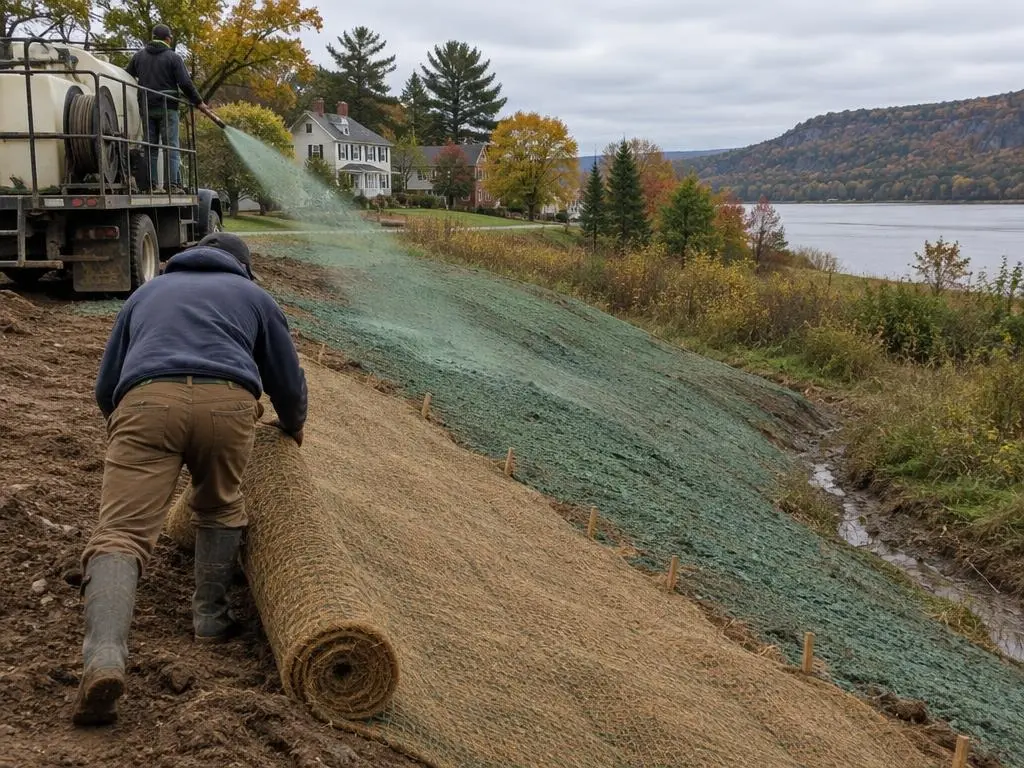
- Bonded fiber matrix. A sprayed mulch with a binder that sets up as one porous, unbroken layer, gripping steeper slopes and rough surfaces where blankets are hard to pin.
- Straw erosion control blankets. Rolled blankets of straw held in a light netting, laid over seeded soil and pinned with staples. A common choice for residential banks.
- Straw-coconut and coir blankets. Longer-lasting blankets for steeper slopes, stronger flows and spots where grass will take more than one season to fill in.
Soils that wash differently
Sandy outwash on the river terraces, like the Hartford soil series, takes in water fast but has little to hold it together once disturbed, and it can slump and wash on even moderate slopes. Glacial till soils like the Wethersfield series are loamier and hold together better, but the USDA notes they occur on slopes up to 35 percent and can carry a perched water table in late winter and early spring. A saturated till slope can slide in a heavy rain. We look at which you have before choosing a treatment.
Swales and ditches
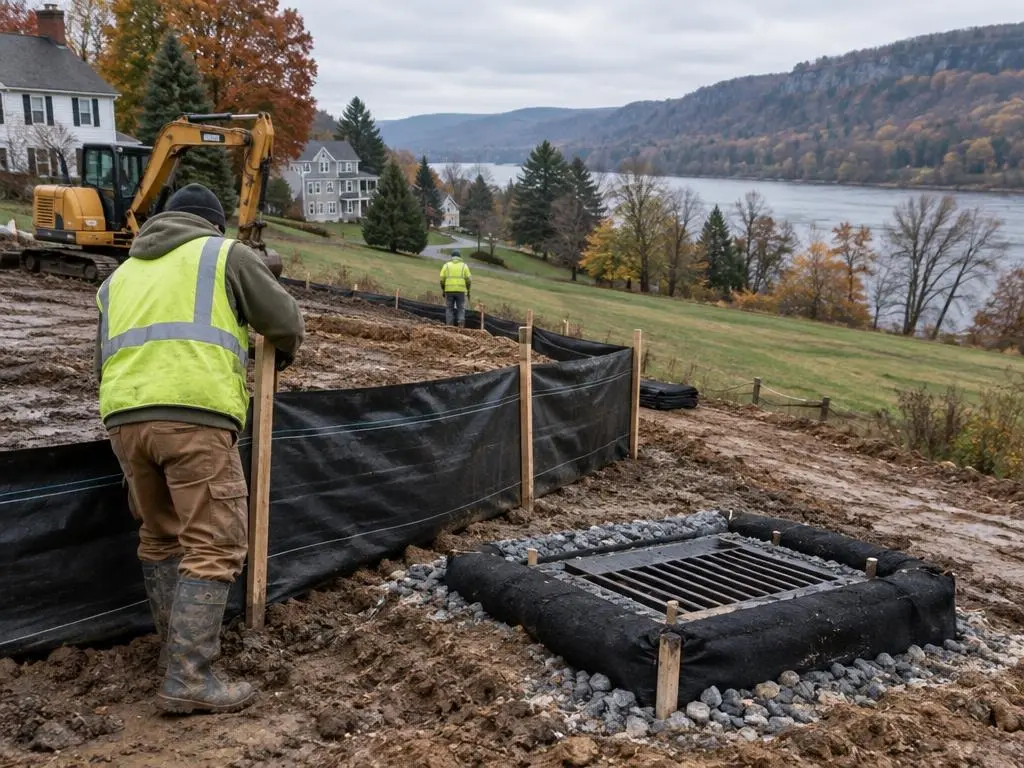
Grass-lined swales are one of the cheapest ways to move stormwater around a house or across a site, but a new swale is at its weakest before the grass roots in. We shape the channel to the right depth and side slope, seed it, and line it with a blanket rated for the flow. On low-flow swales a straw blanket is often enough; where water runs fast, a coir or straw-coconut blanket holds longer.
Slope stabilization on residential lots
Many homes in the hill towns around Hartford sit on graded lots where the builder cut into a slope for the house and driveway. Those cut faces are often thin soil over rock, and they are hard to mow and harder to grow grass on. For banks like these we may recommend a low-maintenance fescue or a meadow-style mix instead of lawn turf, applied with bonded fiber matrix or under a blanket. On fill slopes around new foundations, we make sure the soil is compacted enough not to slump before we cover it.
Living with a stabilized slope
The first growing season is the weak point. Blankets and bonded fiber matrix protect the soil, but they do not replace roots. After the first few heavy rains, walk the slope and look for small rills, blanket edges that have lifted, or places where water is running under the cover. Those are easy to fix early and hard to fix after a summer thunderstorm has turned them into a gully. Water a seeded slope with a gentle spray so you do not wash the seed downhill, and keep mowers and foot traffic off it until the grass is well rooted. On banks seeded with low-maintenance mixes, one or two mowings a year are often enough once the cover is established. If the slope still shows bare patches after the first season, we can come back, touch up the seed and add mulch where it thinned.
Pricing slope work
The blanket and mulch figures in the table are installed unit prices per 1,000 square feet, taken from one state transportation department's 2025 erosion and sediment control rates, and the last row is HomeGuide's slope surcharge for residential hydroseeding. Real costs depend on how steep the slope is, how much prep it needs and how easy it is to get to. We price after we have walked it.
Erosion Control Options
We pick the lightest treatment that will actually hold.
Hydromulch with seed
Fiber mulch and tackifier sprayed with the seed on gentle and moderate slopes.
Bonded fiber matrix
Sprayed mulch that dries into a continuous mat on steep or uneven slopes.
Straw erosion control blankets
Rolled straw blankets pinned over seed on residential banks.
Coir and straw-coconut blankets
Longer-lasting blankets for steep faces and higher flows.
Swale and ditch lining
Channels shaped, seeded and lined to carry water without scouring.
Low-maintenance slope mixes
Fescue and meadow-style blends for banks you do not want to mow.
Erosion Control Unit Prices
| Item | Published price (source) |
|---|---|
| From a 2025 DOT pay-item list: wood-fiber hydromulch, per 1,000 sq ft | $98 |
| Same list: straw-coconut (70/30) blanket, per 1,000 sq ft | $468 |
| Same list: coir blanket of coconut fiber, per 1,000 sq ft | $532 |
| Hydroseeding slope surcharge, per sq ft (HomeGuide) | add $0.05 to $0.10 |
Reference unit prices, not a quote. Steepness, access, prep and the blanket chosen all shift the total. Expect your job to vary. The figure on our written proposal is the one we hold to.
How We Stabilize a Slope
1. Assess
We look at slope, soil, where water comes from and where it goes.
2. Prepare
Rills filled, loose material removed, surface roughened so seed and mulch grip.
3. Seed
Seed and fertilizer applied with hydromulch, or under a blanket.
4. Protect
Bonded fiber matrix sprayed or blankets laid, overlapped and stapled.
5. Check after storms
We recommend checking after the first heavy rains and fixing any weak spots early.
Why Choose Us for Slope & Swale Erosion Control
Right product for the slope
We do not put a coir blanket where hydromulch will do, or the reverse.
Channels sized for the flow
Swales are shaped and lined for the water they actually carry.
Seeding in the same visit
Blankets and seed go on together so the slope is never left half done.
Slope & Swale Erosion Control Questions
What is the difference between an erosion control blanket and hydromulch?
Hydromulch is sprayed fiber that covers the soil and holds moisture; it works on gentler ground. A blanket is a rolled mat pinned to the slope, which holds up better on steep banks and in channels.
Do straw blankets need to be removed?
No. Straw blankets break down as the grass grows through them. Some use plastic netting that lasts longer, so near wildlife areas we can use blankets with natural fiber netting.
How steep a slope can you seed?
With bonded fiber matrix or blankets we can seed most residential banks. Very steep faces may need terracing, retaining walls or plantings instead, and if yours is one of them, you will hear that from us before anything is quoted.
My swale keeps washing out. What do you do?
We regrade it to a stable shape, seed it and line it with a blanket rated for the flow. If water is entering faster than the swale can handle, we look at the source too.
Slope & Swale Erosion Control Service Areas
- Hydroseeding in Hartford, CT
- Hydroseeding in West Hartford, CT
- Hydroseeding in East Hartford, CT
- Hydroseeding in Wethersfield, CT
- Hydroseeding in Glastonbury, CT
- Hydroseeding in Manchester, CT
- Hydroseeding in Newington, CT
- Hydroseeding in Rocky Hill, CT
- Hydroseeding in Cromwell, CT
- Hydroseeding in Berlin, CT
- Hydroseeding in Farmington, CT
- Hydroseeding in Avon, CT
- Hydroseeding in Simsbury, CT
- Hydroseeding in Windsor, CT
- Hydroseeding in South Windsor, CT
- Hydroseeding in Bloomfield, CT
- Hydroseeding in Enfield, CT
- Hydroseeding in Southington, CT
- Hydroseeding in Bristol, CT
- Hydroseeding in Plainville, CT
- Hydroseeding in Vernon, CT
- Hydroseeding in Ellington, CT
- Hydroseeding in Suffield, CT
- Hydroseeding in Granby, CT
Get a Slope & Swale Erosion Control Estimate
Slope and swale estimates across Greater Hartford.